-->
How To Measure & Install Mini Blinds

Search:
Home > Mini Blinds
Email Us
Shopping Tools

GO What's New
GO Fabric Quote
GO My Account

Resources
GO How-To
GO Decorating Sites
GO Link Partners

Shop by Category

Area Rugs
Art
Bedding Ensembles
Blinds
Bronze Sculpture
Comforters
Cornices
Curtain Rods
Decorative Fans
Fabric
Faux Fur
Furniture
Home Decor Accessory
Lamps
Mirrors
Purchasing Info
Stoneware
Wallcovering
Window Treatment

Secure Shopping

Purchasing Info
Acceptance Mark
Maintext
 
Beautifully accent your windows with mini-blinds.

Installing Mini-Blinds

Skill Level: Beginner


Blinds provide light and privacy control for almost any window. Many different colors and styles are available to beautifully accent any room. Blinds require only a few measurements and tools for easy installation.


Article Content

Why Use Mini-Blinds?

When choosing a window treatment, think about the following:

  • appearance


  • privacy


  • light control


  • glare and sun control


  • insulating value


  • ease of operation

Since few window coverings meet all these requirements, a combination of treatments may be the answer. That's one reason why mini-blinds have become so popular. Mini-blinds meet almost all of the major considerations and can be used alone or in conjunction with other window coverings.

The one drawback is they lack insulating value and are not airtight. Blinds are more effective in the summer. They block direct sunlight, but still provide no insulation. Blinds reflect some heat if they are light in color. If you choose blinds in a dark color, think about purchasing duotone blinds for some insulating value. Duotone blinds have a reflective color on the back and show white (or a light color) to the street making them perfect for apartments and condos.

Back to Top

What's Your Style?

Mini-blinds are made of three basic materials:

  • Vinyl - The least expensive variety and very popular as well, vinyl mini-blinds come in standard sizes only.


  • Aluminum - Aluminum mini-blinds offer you a large selection of colors and can be sized to order.


  • Wood - Wood mini-blinds are the most expensive type. You can purchase wood mini-blinds in different wood grains and colors. Like aluminum, wood mini-blinds can be made to order for those not-so-standard widths and heights.
Back to Top

Measuring for Mini-Blinds

Determine the position of the mini-blinds. Will they be inside or outside the window frame? Inside mounting looks more customized, but outside mounting provides better light control.

  • For inside-the-frame mounting, measure the width between the points where brackets will be placed—top, middle and bottom. Record the narrowest of these measurements. Measure the length from the top inside casing to the sill. At least 1" of flat surface is needed on the inside casing to attach the brackets and 2 3/8" is needed for the 2" slats.


  • For outside-the-frame mounting, measure overall width of the area to be covered. Hang your mini-blinds outside-the-frame if there is less than 1" of flat surface on the inside casing. Measurement must overlap the window by at least 1 1/2" on each side. Measure the length from at least 3" above the window to the bottom sill. You need at least 2 3/8" flat surface on the inside casing for the 2" slats.


Back to Top

Installation
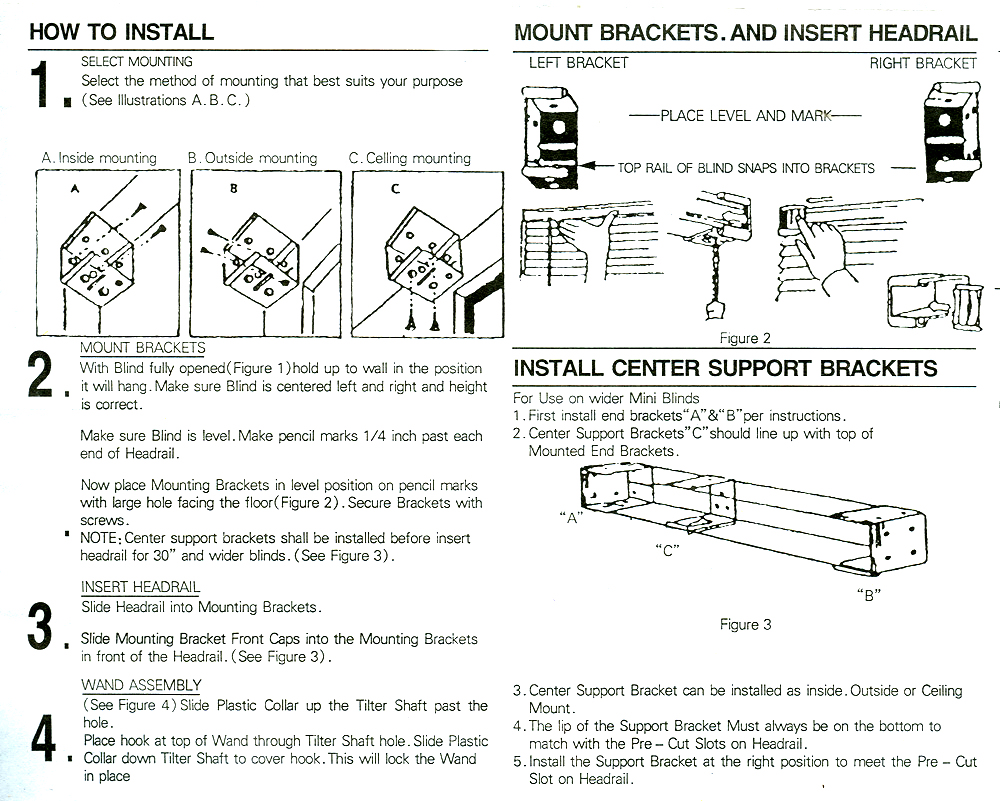
  1. Determine whether you want inside or outside mounting. Measure your window(s).

  2. After purchasing the correct size of mini-blinds, remove the window stop from the top of the window on the window casing.

  3. Screw the brackets (that came with your mini-blinds) to the side window casing at the top, using two to three screws per bracket.

  4. With the wand on the left and lift cord on the right, slide the mini-blinds into the previously installed brackets.

  5. Once the mini-blinds are in place, secure the end caps over the brackets .

  6. If the mini-blinds are too long, simply remove slats from the bottom.

Back to Top

Installing Child Safety Mini-Blind Tassels
Child safety tassels help reduce the risk of self-strangulation.

The use of child safety tassels may help prevent children and pets from becoming entangled in the lift cords, thus helping reduce the risk of self-strangulation.

  1. Install mini-blinds according to instructions provided.

  2. Adjust the mini-blinds so the bottom rail is even with the bottom of the window opening.

  3. Cut the lift cord just above the tassel. Discard the tassel.

  4. Slide the cord equalizer off the lift cord and throw it away. (This will not affect your mini-blinds' operation.)
  5. Cut the cord above the tassel.
    Remove cord equalizer and discard.
    Place replacement tassel on one of the lift cords.
    Tie double knots in the end of both cords.
  6. Put a replacement tassel on one of the lift cords. Tie at least one double knot at the end of the lift cord and slide the tassel down over this knot.

  7. Repeat the previous step for the other lift cord. The whole point is to keep the lift cords separate, so do not tie them together.

  8. Pull on the tassel to test the knot. You may need more than one knot for the amount of pressure you have to put on the tassel to raise and lower the mini-blinds.

  9. To lower the mini-blinds, take both lift cords into one hand and gently pull to the left, releasing the lock. Lower to desired level and pull back to the right to lock in place.

  10. To raise the mini-blinds, gently pull both lift cords to the right at the same time. Raise to the desired level and release the cords.

  11. If the mini-blinds are not level, pull one lift cord at a time to even them.

  12. To keep the lift cords out of children's and pet's reach, place a hook on the window's moulding then wrap the cords around it.

Back to Top